The primary motivation behind developing this device stemmed from observing the hardships faced by farmers during the monsoon season. In rural areas, especially during the rainy season, it is crucial to pump water into paddy fields. Unfortunately, the simple act of turning on a motor has led to many tragic accidents, including electrocutions, as people brave harsh weather conditions to operate these devices.
Similarly, during the winter season, the struggle to walk through cold fields just to turn a motor on or off adds to the daily challenges faced by farmers. Witnessing these difficulties, I realized the need for a safer, more convenient solution and began researching how to address this issue.
Watch Project Video
After extensive research, I discovered that using NodeMCU, a Wi-Fi-enabled microcontroller, provided the most effective way to control electrical appliances remotely. By integrating this technology with Facebook Messenger, I developed a system where users can control devices such as lights, fans, motors, and more simply by sending a message through Messenger.
Advantages of the Device
- Safety: Increased safety by allowing remote control, reducing electrocution risks during harsh weather
- Convenience: Operate devices from home or any location with internet access
- Versatility: Control various appliances including lights, fans, motors, and other electrical devices
- Cost-Effective: Entire system developed for around NPR 3000/- making it very affordable
- Ease of Use: Simple operation through Facebook Messenger, accessible to non-tech-savvy users
Practical Applications
This device is especially useful in agricultural settings, where it can be used to control irrigation systems without the need for farmers to physically be in the fields. It can also be applied in residential settings, allowing users to control home appliances from a distance, which is convenient for the elderly or those with mobility issues.
However, there are some limitations to consider. The system requires a stable Wi-Fi connection, which might not be available in all rural areas. Additionally, reliance on Wi-Fi means that if the internet connection is lost, the device cannot be operated remotely. Despite these drawbacks, the benefits far outweigh the challenges, particularly in regions where safety and convenience are paramount.
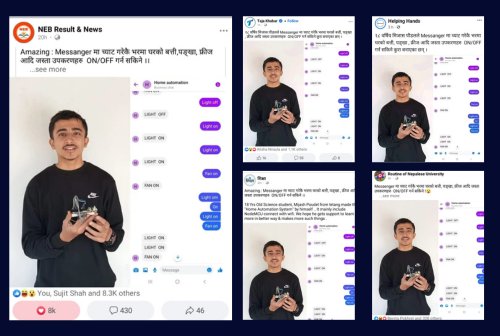
Media Coverage on Social Media
Technical Details and Process
The device's core functionality is powered by a NodeMCU microcontroller, which is responsible for connecting to Wi-Fi and receiving signals. When a user sends a command via Messenger, the NodeMCU receives this signal over Wi-Fi and triggers a relay module. The relay then controls the flow of AC current to the connected appliance, effectively turning it on or off.
The entire process was developed and tested over 10 days, with careful consideration given to both safety and functionality. In addition to the NodeMCU, other components used include a relay module, an adapter, and jumper wires.
Hardware Components Used
- NodeMCU (ESP8266): Wi-Fi enabled microcontroller for connectivity
- Relay Module: Controls AC current flow to appliances
- Power Adapter: Provides power to the system
- Jumper Wires: Connect components together
- Breadboard: Optional for prototyping
- AC Appliances: Lights, fans, motors, etc.
